


It is often hard to determine what is influencing Donald Trump a month into the US and Israel's campaign of military action on Iran.
But it is evident he has an eye on the global crude markets.
A comment – or tweet – from the American leader regarding his plans once would spark substantial moves in oil prices, as market participants seized upon signals the conflict could intensify or de-escalate.
But in the past few days, traders appear to be becoming increasingly sceptical about the impact of his pronouncements.
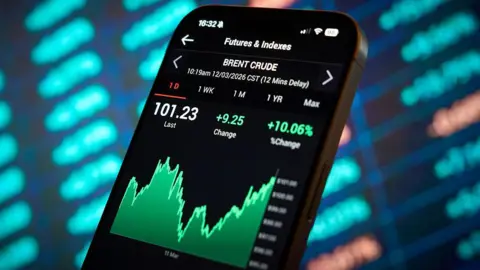
Crude oil was valued at approximately $72 a barrel before 28 February, when the strikes on Iran commenced.
Recently, it reached a high of $118 a barrel on 19 March and as of Friday afternoon was trading at slightly under $112 – substantially up from its pre-war price.
Below are some moments from the last month where Trump and the markets appear to have reacted to one another – with differing impacts.
Use the arrow to move to the next slide.
"Oil prices have become a proxy for broader political and financial uncertainties, jumping when Trump's rhetoric becomes confrontational and easing when his comments softens," says one market analyst.
He adds that financial markets are understandably attuned to those cues, considering the significant financial dangers that come with climbing oil prices.
"Market participants are trying to assess real risk," he comments. "The markets can look skittish or uncertain, but what they're really attempting is managing geopolitical risk in live, with oil acting as the centre of that."
But, it can be tough for investors to determine how to trade, especially since a portion of Trump's comments appear intended to moving oil prices, instead of conveying policy, notes another investment advisor.
"As the saying goes, the first casualty of conflict is clarity," he says. "It is likely some of the rhetoric back-and-forth around successful negotiations, and the opposite, very much are focused on simply moving the price of oil."
Investor Response Grow More Muted
On Thursday, minutes after US stock markets recorded their largest decline since the beginning of the conflict with Iran, Trump stated negotiations with Iran were going "extremely well" and he was postponing military strikes on Iran's oil facilities until at least 6 April.
However, the oil price proceeded to climb.
One currency strategist points out that investor responses are "becoming more muted" because of the "significant disconnect" between Trump's reassurances and the lack of confirmation from Tehran.
"Given the optics, a large number of market watchers do not foresee an imminent conclusion to the hostilities and markets continue to be anxious."
Another investment director says investors have also adapted to Trump "repeatedly shifting position at signs of geopolitical, stock market or financial stress".
"We are seeing a amount of wariness, or even outright suspicion, taking hold at the edges," he adds.


